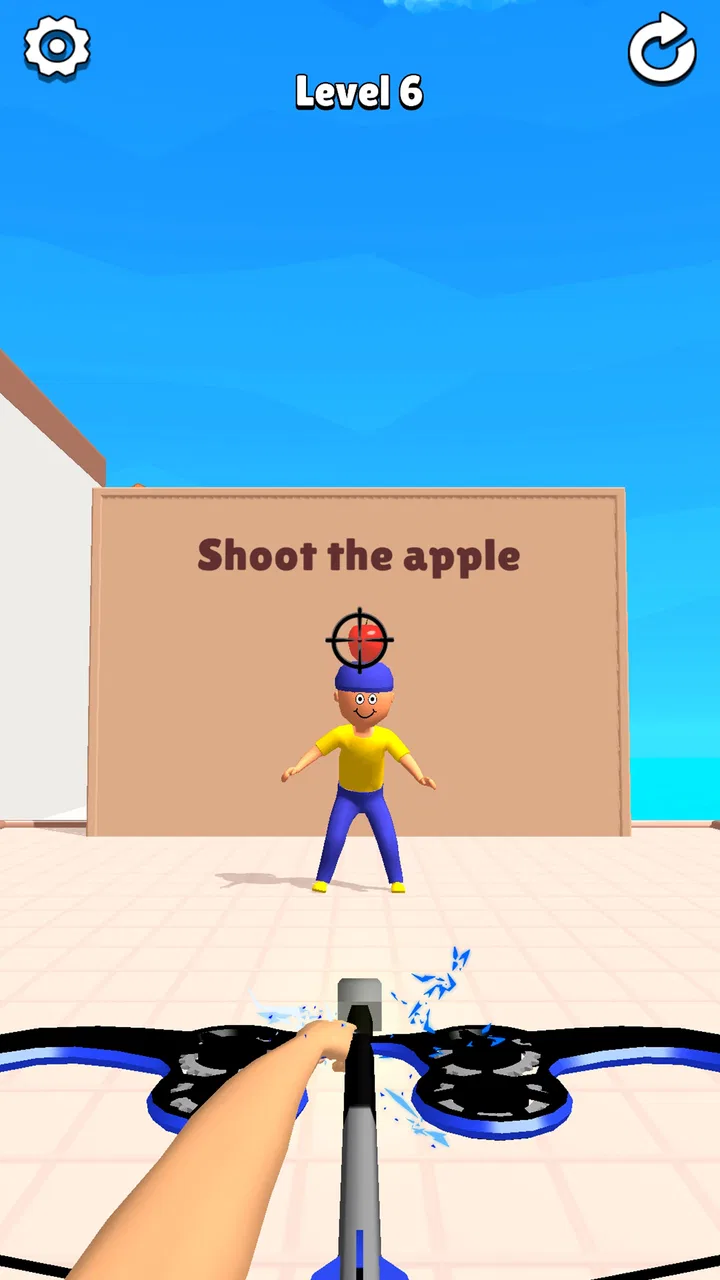
Hit Perfect 3D
- 4.3
- Rating
- 10.00M
- Installs
- Free
- Price

 Analysis by App-foxy
I picked up Hit Perfect 3D expecting a quick arcade distraction, and that is exactly where it works best. It is an adventure game from Supersonic Studios LTD built around timing, aim, and the satisfaction of landing a clean trick shot. The idea is easy to understand within moments, but the small decisions before each attempt give it more personality than the short store summary suggests.
My first impression was that it suits short sessions rather than long, uninterrupted play. I can open it while waiting for an appointment, hand it to someone else on a shared device for a quick turn, or play a few attempts before putting the phone down. It does not ask me to learn a complicated control system, remember a large story, or commit to a lengthy mission. That simplicity is its main strength, although it also explains why players looking for a deep adventure may eventually want something more substantial.
How it works when several people use one phone
The most natural household use I found was passing the device around for individual attempts. One person lines up a shot, makes the throw, and then another person can try to beat that result. This creates a small competitive moment without requiring everyone to install the game or understand a complicated multiplayer setup. It feels closer to a shared puzzle or a quick skill challenge than to a traditional adventure campaign.
You May Also Like

 Blood Strike: 2.5 Anniversary
Blood Strike’s Loadouts Turn Every Drop Into a Tactical Gamble
A close look at Blood Strike’s custom loadouts: how fast access to signature weapons reshapes its battle royale rhythm, rewards preparation, and narrows the gap between fights.

 Pandora - Music & Podcasts
Pandora’s Music Is Easy to Start, but Harder to Recover
Pandora’s strength is its low-effort path from a seed to a station. Its weak spot is how much confidence it asks you to place in connection, setup, and quiet recovery.

 8 Ball Pool
 Is Built on Rivalries, Rematches, and Routine
A close look at the rivalries, rematches, shared routines, and unanswered safety questions that turn a quick pool match into a persistent mobile community.

 Samsung Music
’s Quiet Strength Is Playing What You Already Own
Its reach comes less from spectacle than from dependable access to a personal library. That simplicity is both the app’s strongest retention engine and its ceiling.

 AccuWeather: Weather Radar
AccuWeather Review: A Quick, Clear Forecast for Everyday Decisions
For everyday plans, the best forecast is the one you can understand quickly. AccuWeather makes rain timing, radar, and local conditions easy to act on, with a few trade-offs.

 Hill Climb Racing
Why Hill Climb Racing Still Turns Crashes Into One More Run
A tiny car, a bumpy hill and one more upgrade: Hill Climb Racing keeps resurfacing because its simple chaos makes every near-miss feel personal.
More From Our News Desk
View All News


That format is particularly useful when children and adults are waiting together. A younger player can understand the central goal quickly, while an older player can focus on finer timing and try to improve consistency. I would not describe it as a full family game, because the experience is still centered on one player making a shot at a time, but it works well as a casual pass-and-play activity.
For a shared phone, I recommend agreeing on a simple turn order before starting. Without that small boundary, the most enthusiastic player can easily keep taking attempts, especially when a stage feels close to completion. The game itself is better at providing an immediate challenge than at organizing a group, so the social rules need to come from the people using the device.
A useful household routine is to treat each session as a short challenge rather than an open-ended play period. For example, each person can have a few attempts, then the phone goes back to its owner. This keeps the game from taking over the device and makes the result feel fairer. It also suits the design: the appeal comes from trying to produce a better shot, not from spending a whole evening inside a large world.
What the first session feels like
The controls are approachable because the objective is immediately visible: I am trying to make a precise shot rather than manage several systems at once. That makes the opening minutes accessible to someone who rarely plays games. I did not need a long explanation before understanding what counted as a successful attempt.
The simplicity should not be confused with complete ease. A shot can look obvious and still demand attention to timing and positioning. I found that rushing was usually less useful than pausing briefly to read the situation. That is one of the first practical lessons I would give a new player: do not treat every level as a reflex test. It rewards a moment of observation before committing.
Because the game is free to download, it is easy to try without making the household decide whether it deserves a purchase first. Its Teen content rating is worth discussing before placing it on a device used by younger children, though. The rating is not a substitute for a parent’s judgment, and the right choice depends on the child’s maturity and the way the device is shared.
Keeping the game separate from the device owner
On a family or shared phone, I would establish who owns the progress before anyone starts. A casual player may assume that a few attempts are harmless, but progress can become meaningful to the person who installed the game. If several people use the same device, a simple spoken rule—one person plays, everyone else watches or takes an agreed turn—prevents accidental disruption.
I also prefer having the device owner handle any store or purchase decisions. The game is free, but it includes in-app purchases priced at $2.99 per item. That makes the boundary important when children or guests can use the phone. A player focused on completing a difficult moment may be tempted to spend without fully understanding the consequence, so the person responsible for the device should remain in control of those choices.
This is not a criticism unique to this game; it is simply more noticeable in a title that is easy to hand to another person. A quick arcade challenge can move from one user to another in seconds, while the account and payment responsibility remain with the device owner. I would therefore treat it as a shared activity, not as an unrestricted communal profile.
I would also avoid promising a child that the game is suitable merely because its controls look simple. The Teen label should be part of the conversation before installation. If the intended player is below that age context, an adult should decide whether the content and the store environment are appropriate rather than assuming that the cartoon-like presentation answers the question.
Timing, coordination, and the small details that matter
The most useful way to approach a difficult attempt is to separate reading from execution. First I look at the route and identify what the shot needs to accomplish. Then I make the input deliberately instead of repeatedly tapping in frustration. This sounds basic, but it changes the game from random trial and error into a compact exercise in coordination.
When I played in a noisy room, I noticed that the game was easier to enjoy when I waited for a quiet moment before attempting a precise shot. That makes it a good shared-device game but not always a good background game. Someone can watch another player’s turn, yet the person actually playing still benefits from concentration. In a household setting, asking others not to bump the phone or interrupt during the attempt is surprisingly helpful.
One non-obvious advantage is that spectators can learn from a failed attempt without needing their own session. Watching where a shot went wrong gives the next player a useful reference. I found that this turns mistakes into shared information: one person tests an approach, and the next person adjusts it. That is more engaging than simply waiting for a turn in a game where every attempt feels isolated.
Another practical tip is to use the first attempt on an unfamiliar challenge as information rather than as a verdict. If the shot fails, I pay attention to whether the problem was timing, direction, or an overly ambitious approach. This mindset reduces the urge to repeat the exact same movement. It is especially useful for children, who may otherwise interpret a missed shot as evidence that the level is unfair.
The trade-off is that the game’s appeal depends heavily on whether you enjoy repeating a skill until it feels right. Players who like refining a small action may find that satisfying. Players who want constant narrative progress, character development, or exploration may see the same structure as limited. Compared with larger adventure games, this one gives up world-building in exchange for immediate interaction.
Where it fits among casual adventure games
Many adventure games on mobile try to hold attention with stories, maps, collectibles, or character upgrades. Hit Perfect 3D takes a narrower route. Its focus is the shot itself, so there is less mental overhead between launching the game and playing. I appreciate that when I only have a few minutes, but I would choose a more expansive alternative when I want a sense of journey or a reason to return beyond improving my technique.
It also differs from a conventional sports simulator. I do not approach it expecting realistic team management, a full ruleset, or a detailed recreation of a real discipline. The fun comes from the exaggerated challenge of making a perfect-looking attempt. That makes it easier to share with a non-player, although someone seeking authentic simulation may find the experience too focused and stylized.
Compared with slower puzzle games, it asks for more physical coordination and less extended planning. Compared with reflex-heavy runners, it gives me more incentive to stop and assess the shot before acting. That middle position is useful: it can be played casually, but it still rewards attention. The best audience is someone who wants a compact challenge with visible improvement rather than a large adventure to explore.
What to expect from the current release
The game is currently listed as version 1.3.6 and supports devices running Android 7.1 or later. That makes the technical entry point fairly approachable for people using older compatible phones, although actual smoothness can still depend on the device and its condition. I would install it on the phone intended for regular play rather than assuming that every shared device will feel equally comfortable.
Its audience size also suggests that it has reached a broad mobile player base: the listing shows an average rating of 4.3 from around 73 thousand ratings, with more than 10 million installs. I treat those figures as evidence that the basic loop is easy for many people to pick up, not as proof that every player will enjoy it. A large casual audience can include both dedicated repeat players and people who only wanted a brief distraction.
The game was released on August 30, 2021, so I approach it as an established mobile title rather than a brand-new experiment. That matters for expectations. I am not choosing it because it promises a fresh social platform or an elaborate new system; I am choosing it because the central trick-shot idea remains easy to understand and convenient to share.
One limitation I would mention to anyone installing it for a household is the absence of a built-in explanation for how your group should coordinate turns. The game can support a shared challenge socially, but it does not replace a family agreement about progress, screen time, or purchases. That is manageable, yet it means the adults in the room need to provide the structure.
Who should play, and who should skip it
I would recommend it to someone who likes short skill games, enjoys improving a single action, and wants something that can be passed between people without a tutorial session. It is also a sensible choice for a person who dislikes games that demand a long commitment before becoming enjoyable. The core idea arrives quickly, and a player can understand the appeal through a handful of attempts.
I would be more cautious if the intended player wants a rich adventure with a story, exploration, or a strong sense of character progression. This game’s adventure classification does not mean it behaves like a console-style quest. Its real identity is a focused trick-shot challenge. If the player needs a substantial world to investigate, another genre choice will probably be more rewarding.
I would also skip it for a child if the Teen rating does not fit the household’s rules. The free price makes experimentation easy, but free installation does not remove the need to supervise store decisions or shared-device use. For teenagers and adults who enjoy quick timing challenges, the rating is a useful piece of context; for younger children, I would make the decision carefully rather than relying on the simple presentation.
Players who become frustrated by repeated misses may need to set a clear stopping point. My best sessions ended when I still felt curious about the next attempt, not after forcing myself through a long chain of failures. A short break can be more productive than repeatedly making the same rushed movement, especially when the phone is being used by several people.
My household verdict
After using it as both a solo distraction and a shared-device challenge, I see Hit Perfect 3D as a focused game with a clear place in a household. It is easy to demonstrate, quick to hand to another person, and satisfying when a carefully judged shot finally works. The strongest shared-use experience comes from treating it as a turn-based mini-challenge built by the players themselves.
My recommendation comes with boundaries. Keep purchase decisions with the device owner, agree on turn order, and consider the Teen rating before inviting younger players. Those steps are not complicated, but they prevent the most likely friction. I would also avoid presenting it as a complete family adventure, because its value is narrower and more immediate.
The best reason to install it is its compact skill loop, not the promise of a large game world. I can see it working particularly well during a short wait, a relaxed evening when people want to pass one phone around, or a quick break when I want something more interactive than scrolling. The free entry point makes trying it painless, while the $2.99 individual purchase option means household supervision still matters.
In the end, I would recommend it to friends who enjoy timing challenges and playful competition, especially when they want a game that can be understood without a long explanation. I would point story-focused players elsewhere, and I would make the age decision with the Teen rating in mind. For the right audience, its straightforward design is a strength: one device, one shot, one adjustment, and another chance to make the attempt cleaner.
FAQs for Hit Perfect 3D
01What is Hit Perfect 3D and what can I expect from the gameplay?
Hit Perfect 3D is an engaging action game that challenges players to aim and throw objects with precision to hit various targets. The gameplay is designed to test your accuracy and timing skills across multiple levels. With each level offering a unique set of obstacles, players can expect a mix of strategic thinking and reflex-based challenges.
02Are there any in-app purchases in Hit Perfect 3D?
Yes, Hit Perfect 3D offers in-app purchases. While the game is free to download and play, players have the option to purchase additional items or features that can enhance gameplay. These purchases are not necessary to enjoy the game but can provide a more enriched experience or help progress through challenging levels more easily.
03What are the system requirements for installing Hit Perfect 3D on Android and iOS?
For Android users, Hit Perfect 3D requires Android 5.0 and up. On iOS, the game is compatible with iOS 10.0 or later. It's important to ensure your device has enough storage and meets these requirements to avoid any performance issues. Regular updates may also require additional space or newer OS versions.
04Is Hit Perfect 3D suitable for children?
Hit Perfect 3D is generally suitable for players aged 12 and up due to the mild cartoon violence involved in the game. Parents should be aware of in-app purchases and may want to monitor gameplay for younger children to ensure a safe and appropriate gaming experience. It's always a good idea to check the content warnings on the app store.
05Does Hit Perfect 3D require an internet connection to play?
Hit Perfect 3D can be played offline, which is great for users who want to play on the go without using data. However, certain features like in-app purchases and leaderboards may require an internet connection. Playing online can also provide access to updates and additional content, enhancing the overall experience.
Pros
- Intuitive controls make gameplay accessible.
- Vibrant graphics enhance visual appeal.
- Numerous levels keep players engaged.
- Challenging puzzles improve strategic thinking.
- Offers offline play for convenience.
Cons
- Ads can interrupt gameplay frequently.
- Limited customization for characters.
- In-app purchases can be costly.
- Some levels may feel repetitive.
- Occasional lag on older devices.

Hit Perfect 3D
Gallery